GET FOUND BY READERS, GOOGLE AND AI (+ HOW TO WRITE YOUR AUTHOR BIO.)

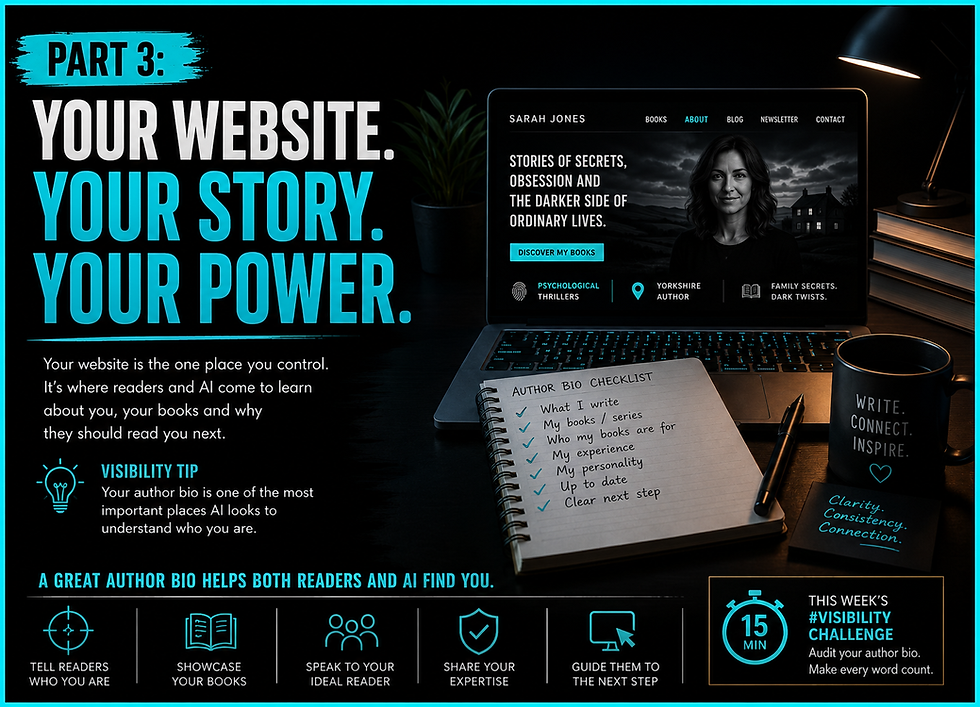 Welcome to part 3 of my series helping you get found by readers, Google and AI.
In Part 1 I discussed what this new future looks like and how this is a huge opportunity for authors to connect with readers and more importantly the other way round <Readers to Authors>
In Part 2 I looked at how discovery is from multiple directions, not just one.
And today I’m going to look at one place in particular that deserves your attention.
|
THE HEADLINE NEWS
Your website has quietly become the most valuable piece of digital real estate you own.
Your website is the one place online where you can create an information treasure chest about yourself.
You can have photos, blogs, About pages, reading lists and much, much more. And guess what AI is looking for, yep, you got it - photos, blogs...
And the best thing, you control what it looks like, and what the content is. You are not told by "a platform" how many words you have, or that your photo has to be a certain size. It's a place where you can "feed" the AI (and the reader) with information about you that might even be unique. It's public and likely to have unique content...
Honestly, your website may have just moved from being “important to have” to one of the most important marketing assets you own..
I can't emphasise this enough. Your website is one of the most important sources AI can use to understand you.
This Week’s 15-Minute #Visibility Challenge
This week: Audit your author bio.
Your bio isn’t just for readers anymore.
It’s one of the main places that search engines and AI systems use to understand who you are, what you write, and when they should recommend you.
If your bio is vague, outdated, or only talks about your personal life, you’re making yourself harder to discover.
Ask yourself, is your author bio helping readers… and AI… understand who you are?
Your author bio has always been one of the most important pages on your website.
But today it has another job, it tells search tools about you, in your voice.
The good news? You don’t need to write like a robot.
In fact, quite the opposite.
Your challenge this week is to spend just 15 minutes reviewing your bio using the checklist below. HOW TO WRITE YOUR AUTHOR BIO FOR THIS NEW WORLD
------------------
1. Is it immediately obvious what you write? Within the first few sentences, someone should know exactly what kind of books you write. Instead of making readers work it out, tell them. Examples:
Clarity beats cleverness every time.
------------------
2. Mention your books or series Don’t make people (or AI) guess. Include your best-known books or series naturally within your bio. This gives readers somewhere to start and helps establish what you’re known for.
------------------
3. Tell readers who your books are for Think about your ideal reader. Are your books perfect for fans of Richard Osman? Do they appeal to lovers of sweeping historical fiction? Are they written for children aged 8 to 12? Helping people recognise themselves in your bio makes it far easier for them to decide they’re in the right place.
------------------
4. Include relevant experience or expertise (This is one bit that most authors forget or leave out.... BUT is more important than ever, because your life story is something only YOU have and is the source of the UNIQUE material that AI loves.)
If your background influences your writing, mention it. Examples might include:
Real-world experience adds credibility and helps explain why you’re uniquely placed to write your books.
------------------
5. Keep the human bits
Readers don’t just buy books. They buy authors.
If you live in Yorkshire with two mischievous spaniels… …love restoring old tractors… …drink an unhealthy amount of coffee… …or spend every weekend hiking in the Lake District… Keep it. Those details help readers connect with you. Just make sure they’re part of a bio that also explains what you write.
For example: Sarah Jones writes atmospheric psychological thrillers set in the Yorkshire countryside, where she lives with her husband and two very opinionated spaniels. Her novels explore family secrets, obsession and the darker side of ordinary lives.
Now you’ve achieved both. Readers get to know you. AI understands your writing.
------------------
6. Naturally include your name Don’t worry about repeating your name once or twice if it fits naturally. It reinforces who the page is about without sounding forced. Write for people first.
------------------
7. Aim for around 250 to 500 words Too short and there’s very little context. Too long and most people won’t read it. For most authors, somewhere between 250 and 500 words strikes a good balance between personality and useful information.
------------------
8. Keep it up to date Ask yourself:
An outdated bio can send outdated signals.
------------------
9. Write naturally Don’t cram your bio full of keywords. Instead, write as though you’re introducing yourself to a reader you’ve just met at a book festival. If it’s enjoyable to read, you’re probably on the right track.
------------------
10. Finish with a next step Once someone has finished reading your bio, what should they do next? Make it easy. You could invite them to:
Don’t leave them wondering where to click next.
Your Visibility Score Give yourself one point for every “yes”.
✅ My genre is obvious. ✅ My books or series are mentioned. ✅ My ideal reader is clear. ✅ My relevant expertise is included. ✅ My personality comes across. ✅ My name appears naturally. ✅ My bio is around 250 to 500 words. ✅ Everything is current. ✅ It sounds like a real person wrote it. ✅ There is a clear next step.
8-10: Fantastic. You’re giving both readers and AI a clear picture of who you are.
5-7: A few small tweaks could make a big difference.
0-4: This is one of the easiest wins you can make this week.
One final thought…
Imagine your bio was the only page on your website that someone, or an AI, ever read. Would they know:
If the answer is “yes”, you’re not just writing a good bio. You’re building one that helps both readers and AI understand exactly who you are.
|
VISIBILITY TIP #3 Open your website and imagine you’ve never visited it before. Ask yourself these five questions.
✅ Within 10 seconds, can I tell what this author writes? ✅ Can I immediately see where to start if they’ve written a series? ✅ Is there an obvious way to join their mailing list? ✅ Is the author’s personality clear? ✅ Would I know what to do next?
If you answered “no” to even one of those questions, you’ve found an opportunity to make it easier for readers (and AI) to discover more about you.
If you want to take this to the next level, get a family member or friend and ask them to open up your website either on desktop or phone and WATCH what they do.
Do they get stumped? Does something confuse them? Can they sign up to your list easily?
Because every extra click… Every moment of confusion… Every missing piece of information… Is another opportunity for a reader to leave.
Next time, we’re going to tackle one of the biggest myths surrounding AI.
How does ChatGPT actually know anything about authors?
The answer is fascinating. And understanding it may completely change the way you think about author visibility.
|


Comments