HOW DOES AI KNOW WHO YOU ARE? YOUR AI VISIBILITY

GETTING FOUND PART 4

Welcome to Part 4 of my series about helping readers find you.
In Part 1, we looked at why readers need to discover the author—not just an individual book.
In Part 2, we explored the author ecosystem and all the different places discovery can begin.
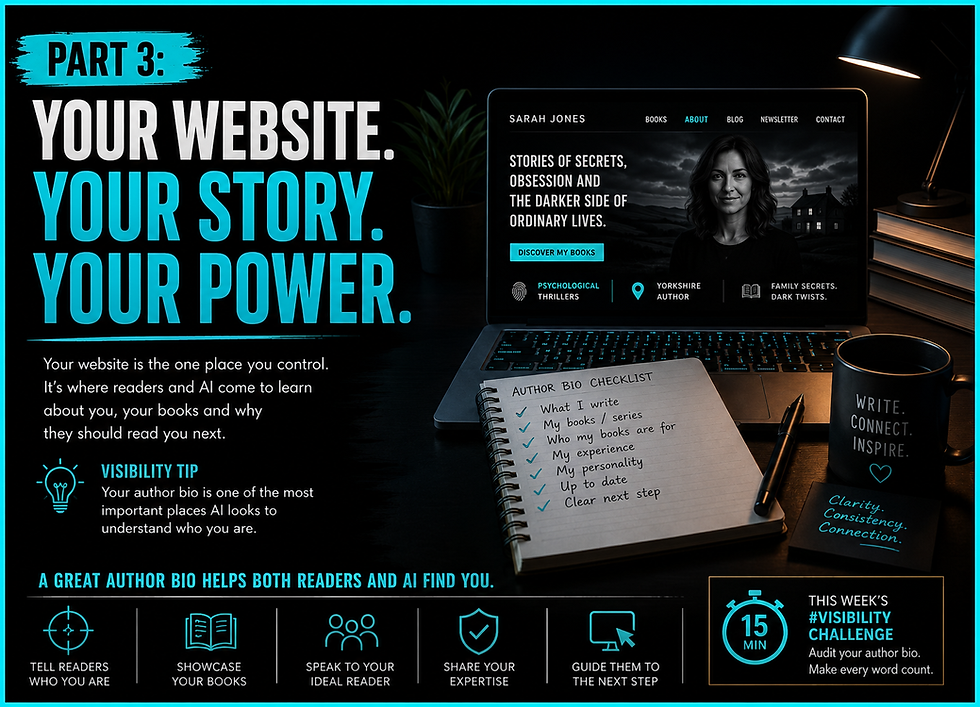
In Part 3, we looked at why your website may now be the most valuable piece of digital real estate you own.
Today, I want to answer the question I promised to tackle: How does ChatGPT actually know anything about authors?
|
THE HEADLINE NEWS
ChatGPT (or any AI) does not have a secret directory containing every author, book and biography.
It does not “know” you in the way a reader might. Its answers can come from three places
That might include:
|
THE JIGSAW PUZZLE
AI is basically trying to piece together a picture of you from whatever reliable information it can find online. Your website might tell it what you write, Goodreads helps link your name to your books and series, while Amazon adds your biography and publication details. Interviews, reviews and articles can add even more context. The more of those sources that agree with each other, the easier it becomes to build an accurate picture of who you are, what you write and, importantly, who your books might appeal to. |
WHAT IF THE PIECES DON’T MATCH?
Your website says you write psychological thrillers. Goodreads calls you a romance author. Amazon is missing your latest series. And an old interview mentions a book you abandoned six years ago.
A reader might eventually work out what's going on, but AI has to make sense of all those conflicting signals too.
That is why consistency matters. The clearer your public information is, the easier it becomes for readers, search engines and AI tools to understand: • who you are • what you write • which books belong to you • how your series fit together • who your books are for |
THERE IS NO MAGIC BUTTON
Updating your website today does not mean AI will suddenly wake up tomorrow shouting:
“I KNOW EVERYTHING ABOUT AUTHOR SARAH JONES!”
Sadly, there is no magic button marked: “Please recommend me to millions of readers.”
Changes can take time to filter through, and you might get a different answer depending on which AI you use or even how you ask the question. And, of course, none of this guarantees that AI will suddenly start recommending your books.
This isn’t about tricking AI. It is about giving readers and technology clear, accurate and consistent information.
|
WHY YOUR WEBSITE MATTERS FOR YOUR AI VISIBILITY
This brings us back to the email I sent in Part 3.
Your website is where you can give the fullest and most accurate picture of yourself as an author. You can explain what you write, introduce your books and series, give readers the correct reading order and talk about the themes, experience and personality behind your work. Then your other profiles back that up. When Goodreads, Amazon, BookBub and the other places you appear online are all saying roughly the same thing, there is far less room for confusion. All of this contributes to your AI VISIBLITY.
The jigsaw starts to fit together.
|
THIS WEEK’S 15-MINUTE VISIBILITY CHALLENGE
Open ChatGPT (or your preferred AI) and enter:
“Search the web and tell me about the author [YOUR NAME]. What genres do they write in, what are their main books or series, who are those books for, and in what order should the books be read? Please show me the sources you used.” If you share your name with another author, include the title of one of your books.
Then check:
☐ Has it found the correct person? ☐ Is your genre accurate? ☐ Are your main books included? ☐ Is your latest book there? ☐ Is the series order correct? ☐ Are the sources actually about you? ☐ Does it find your website?
|
Don't worry if it gets things wrong, that's actually useful. What you're looking for here are the gaps, mistakes or outdated information that might be confusing both readers and AI about you and your books. Choose the biggest error and correct it at the source you control. Your website is usually the best place to begin. Then check whether the same outdated information appears on Goodreads, Amazon Author Central, BookBub or your other profiles. Small corrections across your author ecosystem can create a much clearer picture.
|
VISIBILITY TIP #4 FIX STUFF
If your test throws up ten different problems, don't give yourself ten jobs. Start with the one thing that is most obviously wrong and fix that first. Then come back to the others. Improving your visibility isn't a one-day job, it's a series of small corrections that gradually make the picture clearer.
|
Authors often ask:
“How do I get AI to recommend my books?”
The question you should really ask is:
“Have I given readers and AI enough clear information to understand why my books might be right for them?”
Because before readers can become fans, they need to find you. Keep checking back for more tips on how to make yourself visible. |


This article clearly explains how AI pieces together an author's profile from various online sources, highlighting why consistency across platforms is vital for "AI visibility." The "jigsaw puzzle" analogy effectively illustrates why clear, accurate data is essential for both AI and readers to understand an author. Cellesim This emphasis on a consistent author ecosystem is incredibly practical advice.